Saturday, April 23, 2016

Saudi Arabia's top cleric defends female driving ban saying women would be 'exposed to evil'

This news story came out on April 12, 2016. This blogger has been reluctant to post it, as it seems like nothing new. However, events have  followed on this opinion so I am posting it. A link to the story in the UK's Telegraph is here, with the story pasted below.


Saudi Arabia’s most senior cleric has defended a ban on women driving by claiming it would "expose them to evil".
Grand Mufti Sheikh Abdul Aziz bin-Abdullah al-Sheikh said men “obsessed with women” and with "weak spirits" could end up causing female drivers harm and that male relatives would not know their whereabouts.
Although women driving in Saudi Arabia is not against the law, in practice women are unable to obtain driving licences.  Exceptions are occasionally made in rural areas if a woman needs to drive for her family life.
Grand Mufti, Sheikh Abdulaziz al-Sheikh
Grand Mufti, Sheikh Abdulaziz al-Sheikh Credit: AFP
According to The Independent, the grand mufti made his comments on a Saudi television channel.
The kingdom's most senior cleric is well known for his outspoken positions and earlier this year issued a fatwa saying chess was forbidden in Islam as it promoted gambling.
Saudi Araba has made some recent progress on women's rights. Last year women were allowed to vote for the first time.
Allowing women the freedom to drive remains a distant hope.
Last year  Loujain al-Hathloul was jailed for 10 weeks after violating the ban by driving from the United Arab Emirates to the Saudi border.

Tuesday, March 15, 2016

Women's Right to Drive

Impassioned opinion piece in the March 14, 2016 edition of the English language daily Saudi Gazette, calling for women to get the official right to drive in Saudi Arabia, from one of the women serving in the Shura Legislative Council of Saudi Arabia, Dr. Thuraya al-Areed. The text is pasted below, and a link to the story is here.


Dr. Thuraya Al-Areed
RECENTLY we celebrated the World Women’s Day, remembering women’s great achievements and at the same time reminding the world of their many sufferings. On this occasion, we also remembered the circumstances that helped women to prove their capabilities to make outstanding contributions to society. At the same time we expressed our deep sorrow over the continuing suffering of the vast majority of women around the world.
With the support of modern technology we can now see what used to be hidden behind the walls. We have seen a video clip of violence against a little girl named Noura, who was sexually abused by her father, that went viral on Twitter. It was followed by a WhatsApp campaign to support Noura and save her from the deviant father. Social media also discussed the role of the Justice Ministry, Social Affairs Ministry and the Shoura Council in protecting the girl, especially after her mother had threatened to take legal action against her for slandering her parents.
During a WhatsApp conversation, an educated young Saudi man asked me about the progress achieved by women in general in the last three years since women members were appointed to the Shoura Council. He bluntly asked me what did we achieve for women as Shoura members. He also asked why we did not call for a resolution that would provide woman all her rights as a citizen, including the right to drive. He wanted his wife to support him in all affairs of life, instead of becoming a burden on him. I apologized to him for failing to win a positive decision on women driving yet.
Life would become much easier if Saudi women, among them your sisters and wives, were able to drive inside their country like they do abroad and like women in other parts of the world. Our continued hesitation will only delay a decision on this all-important issue and we will pay dearly for this indecision at economic and social levels.
The Shoura Council has achieved a lot for women in the past three years. The most important among them was the approval of a proposal to amend the Personal Status Act. The motion received 96 votes against 23. The move was aimed at correcting social customs and negative practices and protecting the rights of families, especially children. The legislation also sought to stop individual excesses and mutual hatred while putting an end to the practice of taking revenge against the weaker side, including children.
Every man does not follow the Shariah instructions with regard to family
relationship and give woman her rights based on the Qur’anic teaching: “Either keep her in an acceptable manner or release her with good treatment.” Every day we hear about cases of children and their mothers suffering as a result of their father refusing to give them their birth certificates and other documents to prove their nationality or preventing them from traveling abroad or renewing their passports.
These abhorrent practices occur at all levels of society, irrespective of their educational and financial status, not to mention sexual harassment and bullying. Criminal charges should be brought against people who are accused of committing such offenses.
The call for preventing crimes against women and children does not mean men get their full rights. But women in their present condition are unable to protect their rights and the rights of their children even if they maintain strong bonds with their sons to fill the vacuum created by the head of the family. As a result of this, the amendment of the Personal Status Act became necessary to protect the rights of women and children from the deviant mentality and evil intentions of the male head of the family.
In an atmosphere of official and social laxity, people often try to circumvent rules and regulations and violate the rights of the weaker sections of society. As a result, women right issues in the Kingdom draw the media attention all over the world. In every society there will be special issues apart from the general ones like the demands for equality and human rights. Here we want to restore the right to driving a car.
On the Women’s Day and in the era of firmness, decisiveness and justice, I foresee that women would receive all their rights. I am optimistic about our decision-makers when I ask them when we will celebrate the decision to give women all the rights of citizenship. Women issues in our country are smeared with burning tears, if not bloody bruises. Individual dealings often contradict with established rights that protect women and children against oppression, harassment and dispossession of their legitimate rights, such as chastity, inheritance and wage.

Wednesday, January 27, 2016

An Argument Demanding a Second Look

This opinion piece on the English language daily the Saudi Gazette of January 27, 2016 was written by Tareq A. Al-Maeena. A link to his article is here, and the text is pasted in below.

Many Saudi visitors to the UAE on their return to the Kingdom are heard to mutter: Why them and why not us?  The country has in recent times become a draw for Saudis wanting to escape abroad for a short holiday. Tourists have been flocking to the UAE by the hundreds of thousands.  And they don’t visit only once. Families make up the bulk of visitors, but there are also a sizable number of single males and females who venture to the Emirates on their own.
What is it that attracts these visitors from a nearby country?  It is certainly not the weather as there are no significant climatic differences between the two countries.  Nor is there a dramatic change in topography that might induce some to visit.  Shops and restaurants are not much different in both countries.  Yet in the balance of travel, visitors from the Saudi side most likely outnumber their UAE counterparts by 10 to 1.
There are significant reasons why Saudis would make the trip from the Kingdom to the UAE.  The first is that they find the UAE more similar than different from their own culture.  And besides a host of other reasons such as world class entertainment, there is the compelling draw of a country that places no unjustified restrictions on its women.
A resident of Jeddah explained her own reasons why she chooses the UAE during the holidays rather than spending her time in the Kingdom.  She says: “It’s all about personal freedom.  The UAE is an Islamic country which follows a similar code to Saudi Arabia, yet allows women choices that we find denied here.  And the number one irritant and nuisance to all women here is not allowing them to drive their own cars.  Perhaps we can attempt to get a discussion going in the Shoura Council pertaining to this matter by using a different logic; perhaps the argument of conservation?”
Her novel argument went as follows: “The fastest and least expensive way to conserve water and other resources in Saudi Arabia and save some of our outbound tourist dollars would be to allow women to drive! Where is the connection? Allow me to give an explanation in a very rough estimate of figures:  If women were given the right to drive, approximately one million drivers could eventually be sent back to their home countries. Each one of these men uses about 300 liters of water a day, (about 1/3 cubic meter).
That’s 300,000,000 liters per day for a million drivers. That’s 90,000,000,000 liters per year, with allowances made for their vacation time. That’ 90,000,000 cubic meters per year of water consumed by drivers alone.
“The desalination plant in Saudi Arabia produces 1,000,000 cubic meters of water per day. That’s 365,000,000 cubic meters a year. If we had a million less drivers we would only need 275,000,000 cubic meters. The Shuaiba desalination plant would thus have 25 percent surplus water for people to use if women could drive their own cars. Double check the math.
“The same approximate figures would hold true for electricity consumption.
Even if drivers were to be slowly phased out, this would amount to an enormous saving for the country in terms of water, energy, and of course finances as well. The employment of drivers is becoming an increasing financial burden. Some women’s salaries are spent solely on a driver. Should women  then not receive  government  subsidies for  each household, as compensation for the expenses of having to pay recruiting agencies, visas, air fare, medical check-ups, driver’s licenses, traffic tickets, extra living quarters, furniture, insurance, meals, medical bills and medication, and of course water and electricity, etc., in addition to drivers’ salaries?
“What a huge financial burden for a country with a shrinking middle class, and with minimum wages not much higher than that paid to a driver brought in from a developing country, many of whom have never driven a car before coming to work in Saudi Arabia. That brings up the safety issue as well: safety on the road, safety allowing one’s children day in and day out in the presence of a stranger.
“Which leads me to my next point. The burden of women being banned from driving is also of a psychological and social nature. How has a conservative society such as Saudi Arabia ever allowed itself to bring total strangers into their homes, not knowing the slightest thing about their past, or their moral conduct? It’s a mystery. The whole issue of the ban on women driving is a mystery and a paradox.  And you wonder why we all escape to the UAE?  Perhaps it’s because they have got it right!”
And thus the woman concludes her argument with new reasoning.  The fact that she has chosen an original slant to a social issue indicates that this issue will simply not go away.  Nor will those marginalized by these restrictions remain silent. The issue should not be blanketed by the traditions and beliefs of some. One must not be dismissive of her arguments but look at the overall impact through the eyes of this woman.
– The author can be reached at talmaeena@aol.com. Follow him on Twitter @talmaeena

Friday, January 22, 2016

Driving Change: UO grad sees change arrive for women in Saudi Arabia

Article from University of Oregon (USA) about Aisha Almana, one of the original women drivers in 1991 in Riyadh. A link to the story is here,  and it's pasted in below. The article is by Melody Ward Leslie.

At a time when most Saudi women received little or no formal education, one future Duck set out on a quest that eventually led to a PhD. Then she returned home to become her country’s leading activist for justice, equality, and respect for women.
Aisha Almana
Aisha Almana, BS ’70, thought she was at the airport to see her father off. Instead, he led her to the plane and explained that he was bringing her to Egypt because their own country, the Kingdom of Saudi Arabia, had no schools for girls.

She was eight years old. Bursting into tears, she asked, “Where is my mother?”
Sheikh Mohammed Abdulla Almana knelt to be eye-to-eye with his daughter. “I don’t want you to be like your mother or your grandmother,” he told her. “That’s why I am taking you to be educated. I want you to come back and help the women of your country.”
With these words, he launched Almana toward a place in history as the mother of Saudi feminism.
Four years later, armed with a sixth-grade certificate of completion, she returned home to Khobar just as Saudi Arabia was opening its first schools for girls. All the teachers were wives of workers from non-Arab countries because most Saudi women were illiterate. Sheikh Almana wanted to set a precedent, so he installed his now-13-year-old daughter as the region’s first female school principal and gave her behind-the-scenes daily advice on how to run the school.
“All of the students were in the first grade, even though many were my age or older,” she says, noting that she worked as principal for one school year and then went to Lebanon to continue her education.
She has since achieved a series of firsts in a wealthy country that still denies women basic rights. To the outside world, she’s best known as a leader of the historic 1990 protest against Saudi Arabia’s ban on women driving. The protest was Almana’s idea, and it grew out of her experiences as an undergraduate sociology major at the UO.
“The University of Oregon gave me the opportunity to recognize that I am a human being equal to anyone else,” she says. “I am a free soul, and I am my own driver.”
Going to college in the United States was also Almana’s idea. When her father refused to pay for it—but didn’t forbid her from going—she made her own way by winning a scholarship. She arrived in Eugene in September 1968 and found a campus bubbling with antiwar protests and demonstrations for women’s rights.
For a young woman from a kingdom where freedom of speech was unheard of, the notion of civil disobedience as a tool for social change represented an entirely new way of thinking.
“It was an eye-opener, this idea that you have the right to express yourself and you can differ with others, but it doesn’t mean you are enemies,” she says.
"I am a human being equal to anyone else. I am a free soul, and I am my own driver."
However, she credits her awakening as an activist to a demonstration of a different sort. On her first day of classes, a professor greeted students by placing a jar of pebbles on a table and pronouncing it full. Then, he closed the door and started taking off his clothes.
“I was shocked,” she says, her eyes still widening at the thought of it 45 years later.
She hardly had time to absorb that it was a trick (he was wearing another layer of clothing) when the professor dumped sand into the jar. Was it full now? he asked. Almana thought so, but next he poured in water, which settled into crannies hiding between the rocks and grains of sand.
“This affected me tremendously,” she says. “He showed how what you see is not the reality, and things can change.”
Things can change.
In that spirit, Almana and 46 other women summoned their courage and met at a Safeway parking lot in Riyadh 25 years ago this November 6. They piled into 14 cars, formed a convoy, and drove sedately through the busiest part of the city. On their second lap, members of the Commission for the Promotion of Virtue and the Prevention of Vice reported them, and came with the police to arrest them.
All the women—drivers and passengers alike—were thrown in jail. In mosques across the kingdom, imams denounced each woman, by name, as immoral. Their passports were confiscated. Those with government jobs were fired. Fortunately, Prince Salman, who became king in 2015, intervened so they wouldn’t fall into the hands of religious extremists. Eventually, their passports and jobs were reinstated.
“It was worth it,” Almana says. “We made a statement about the right to drive our own lives.”
Nevertheless, the driving ban still holds, along with a host of other restrictions. Women cannot interact with men. They must obtain written permission from their male guardians—and a chaperone must accompany them—every time they want to go anywhere or do anything outside their homes or workplaces.
The endless taboos range from financial (women can’t open bank accounts without their husbands’ approval) to impractical (they can’t try on clothes while shopping).
Almana says research indicates the exceptional mistreatment of Saudi women stems from misinterpretation of Islam, cultural differences between nomads and city dwellers, and US foreign policy decisions that backfired. “They thought they were fighting communism and they ended up with Al-Qaeda, bin Laden, and Khomeini,” she says.
A devout Muslim, Almana began reading the Koran as a child, and she says it teaches that women and men are equal.
“At least two clergymen have come forward to say their research found nothing in the Koran to require guardianship, yet hundreds of regulations require a guardian’s permission,” she says. “We discovered that most were created by civil servants, based on their personal or tribal traditions or beliefs, without having any basis in Islam.”
Change is slow, but Almana sees signs of progress. More than 56 percent of Saudi college students are now women. Polls show a majority of Saudi men favor letting women drive. In August, for the first time in history, Saudi women began registering to vote.
Meanwhile, despite the fact that she directs the largest group of hospitals in the kingdom’s Eastern Province, which borders the Persian Gulf, the authorities arrest Almana at least once a year. “My poor husband always has the burden of being told to try to control his wife,” she says with a gentle laugh. “They don’t know that he married a woman who cannot be controlled and cannot be owned.”
Suddenly tears well up in her warm brown eyes. None fall, but her voice becomes heavy with grief.
“Do you know,” she asks, “that in Saudi Arabia, a husband or a guardian is not punished if he intentionally kills his wife or his daughter? A father beat his five-year-old daughter to death because he suspected her of sexual activity.
“He could kill her because he owned her. This is what we want to change.”

Melody Ward Leslie, BA ’79, is a UO staff writer.
You can watch Almana speak at an event sponsored by the UO's Global Studies Initiative here.


Wednesday, December 9, 2015

Washington Post: Saudi officials once jailed this woman for driving. But she found her way back on the ballot.

Saudi activist Loujain Hathloul as she drove toward the Saudi border in December 2014. (Loujain Hathloul/AP)
Brian Murphy of the Washington Post writes (December 9, 2015) about Loujain Hathloul who is a candidate in the upcoming municipal elections in Saudi Arabia. You can link to the story here, and the text is pasted below.

She was jailed for 10 weeks for driving. But Saudi officials will let her run.
In a surprise reversal Wednesday, Saudi Arabia lifted its election block on activist-slash-candidate Loujain Hathloul, who gained fame last year by live-streaming her defiance of the kingdom’s ban driving for women.
The decision clears the way for Hathloul’s name to be on Saturday’s ballot in Riyadh as part of nationwide races for municipal council seats – the first elections in the ultraconservative kingdom to allow women to compete and vote. More than 900 women are among the nearly 7,000 candidates.
Until late Wednesday, Hathloul was blackballed along with some other prominent women activists – including two human rights campaigners. For weeks, Hathloul had pushed back, seeking some leverage to get officials to reconsider the ban.
She gave interviews to anyone who would listen. She used connections within the ruling system to lobby for a review of the ban.
“Basically, I annoyed them,” she said. “I guess it worked. It’s amazing news.”
Saudi officials have given no public explanations at the rollback -- just as they made no formal disclosures on the reasons for keeping some candidates off the election lists.
But what likely tipped the scales was a relentless social media blitz by Hathloul’s supporters. Saudi rulers have long conceded ground to online critics – giving them ample room to grouse, network and muse. Crackdowns come when it crosses over into what authorities perceive as challenges to the state or status quo – meaning the ruling family and the powerful religious establishment that has a hand in all key decisions.
This week, however, all of Saudi officialdom is looking to make a good impression with the world’s media shifting its attention to the elections. It's unclear whether the ban will remain in place for the two other women rights activists.
“After I was banned, I wanted to make sure I wasn’t ignored,” said Hathloul. “This means, of course, making some noise.”
She’s no stranger to that. In late 2014, Hathloul got in a car in the United Arab Emirates and drove toward Saudi Arabia with a video camera and her UAE driver’s license. Part of the trip was live-streamed onto the Web.
She was arrested by Saudi border officials and spent 73 days in jail, making her for a time among the best-known Saudi activists.
A year earlier, her husband-to-be, a well-known Saudi satirist named Farhad Albutairi, helped produce one of his memorable videos: “No Woman, No Drive” to the tune of the Bob Marley classic “No Woman, No Cry.”
Hathloul said her initial motivation to run for a council seat was simply to boost the number of women taking part. After the ban, she now wonders if she could pull off a win.
 “The goal has changed,” she said. “I want to make a point. It’s a personal thing now. The municipal councils have nothing to do with the driving ban. The councils are just about fixing up the community. The driving ban is another fight. It's definitely not forgotten.”
Brian Murphy joined the Post after more than 20 years as a foreign correspondent and bureau chief for the Associated Press in Europe and the Middle East. He has reported from more than 50 countries and has written three books.

Wednesday, September 30, 2015

New Petition to Urge GM Boycott of KSA until Driving Ban Lifted

There is a new petition up on change.org urging the CEO of General Motors, Mary Barra, to boycott Saudi Arabia until the ban on women driving is lifted.

You can link to the petition here and sign your name if you wish.

The iniquity of imposing a ban and fees

Great post (Sept 26, 2015) from Saudi Women's Weblog about the driving issue. A link to the post is here and I'm pasting in the post below.

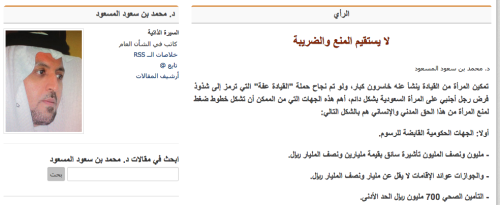
One of the biggest misconceptions about Saudi Arabia is that the ban on women driving is societal. As a matter of fact, women driving is only prohibited in the cities. In traditional rural areas, women drive with no objections by society or government. If tribes living their traditional lifestyles in their villages have no objection to women driving, why would their more modern urban counterparts object? The answer is they don’t either. Women and men across the country have defied the ban either by driving or speaking out with no societal consequences but rather governmental. People have been suspended from their jobs, imprisoned and banned from travel simply for wanting the ban lifted. There is no definite answer as to why the government will not allow each woman to choose for herself whether or not to drive. However, there have been a few analyses as to why the ban is so strictly implemented. One of these is this article by Dr. Mohammed bin Saud AlMasoud published in Aleqtisadiah Newspaper on 19/July/2014. Here I’ve translated it for everyone:
Screenshot 2015-09-26 22.59.22
Lifting the ban on women driving will result in big losses for many. The
Lifting the ban on women driving will result in big losses for many. The campaign Women Driving is More Chaste addresses the abnormality of permanently imposing a strange man on Saudi women. The success of this campaign will be challenged by three institutions. These institutions will most likely constitute pressure lines to prevent women from obtaining the human and civil right of driving their own cars.
First: Fee-charging government bodies
– One and a half million drivers’ visas worth two and a half billion SAR (six hundred sixty-six million USD).
– The General Passports Department earns one and a half billion SAR (four hundred million USD) from residency fees.
– Health insurance fees bring in a minimum of seven hundred million SAR (a hundred eighty-six million USD).
Thus, the Interior Ministry will lose approximately five billion SAR (a billion and three hundred thirty-three million USD) if women driving were to be legalized. These enormous returns will start to dwindle and fall until ultimately they become nothing. It’s no wonder that the Interior Ministry is not overly enthusiastic about the idea of lifting the ban and are firm and strong against women who attempt to exercise their right to drive.
Second: Taxi companies
The vast majority of this companies are owned by elites. 85% of their business depends on women seeking transportation in the bigger cities. These businesses generate unbelievably huge sums that reach to five million SAR (a million and three hundred thousand USD) a month. Naturally, if women were allowed to drive, this enormous financial resource will gradually dry up. Hence those millions a month will be no more. Again, it’s no surprise that these elites would not be too excited or happy to see the ban lifted. This is what happen in Qatar when they lifted the ban on Qatari women driving. The taxi companies’ profits fell to a quarter of what they were. It is especially worrying for the Saudi companies now that taxi charges rose a 100% in the cities after fees on foreign recruitment rose.
Third: Recruitment agencies and airlines
When we talk about one and a half million visas then we are also saying one and a half million flights worth up to three billion SAR (eight hundred million USD), as well as one and a half million recruitment contracts valued at eight billion SAR (two billion USD) minimum. The price of recruiting one driver from abroad is about eight thousand SAR (two thousand USD) which adds up to thirteen billion SAR (three and a half billion USD). That is a number that would be difficult to let go. Experts are forecasting that under the current ban the number of drivers is expected to double to three million foreign drivers. Thus, these profits will also increase a 100%.
All the billions mentioned above are paid by Saudi families and specifically Saudi women, not once but many times over. What’s more, financial penalties up to twice the original cost are imposed if there is any delay in payment. For example, the driver’s residency renewal fees double if they are not paid on time.
Hence, we have so many winners at the expense of Saudi women. Women, who are weak, tender, helpless citizens in need of protection and care, represent 60% of humanity’s workforce, and yet women have to bear all these consequences. Since the ban on women driving is implemented with threats of firmness and strength against all who defy it, it would only be fair to revise all these driver recruitment fees and fines. These fees add up to about six billion SAR (one and a half billion USD) paid by Saudi families, in particular, Saudi women because drivers are imposed on them by necessity.