Opinion piece in the Saudi English language daily, the Saudi Gazette of January 14, 2017, penned by Yousef Al-Mehaimeed. A link to the story can be found here and the text is below.
Decades have passed and some social issues remain
unresolved. Most members of the public consider these issues complicated
and feel that they cannot be solved while other countries, including
some Gulf states, view them as natural obstacles that can be overcome.
Why is it that neighboring countries with which we have many things in
common in terms of heritage, history and traditions, have solved these
problems while we have not? People around the world are making fun of
us.
Several of these issues are related to women driving,
traveling and exercising. In other words, the main issues are about
women. We have not taken any drastic action to end these problems. As a
result, we continue to suffer socially and economically. I would like to
focus here on those detractors who describe male guardians who allow
their female relatives to work in the medical field as men who lack in
manhood.
I do not understand why these people hold this viewpoint. It
is really a shame and a disgrace. Do they want our hospitals and
pharmacies to be run by expatriate doctors and nurses? Why do they
accuse male guardians of not being proper men? What if there was a war
or some sort of dispute that led to these expatriate nurses and doctors
returning home, what would we do?
Around two decades ago, our country experienced tough and
harsh economic conditions. We had to find an alternative income source.
One of the suggested solutions was to impose a tax on expatriate workers
in our country. When the medical circles got wind of the suggestion,
many expatriate doctors and nurses working for a big hospital in Riyadh
went on strike.
Work at the hospital came to a complete halt, which resulted
in exacerbating the health conditions of some patients who were
suffering from dangerous medical problems. The imposition of taxes on
expatriates never materialized because we did not have Saudi
replacements that could run the hospital.
Today, there are some Saudis who are against giving women an
efficient role in building our economy and permitting them to take on
more social roles. But if a disaster occurred and our security
conditions deteriorated and expatriate workers decided to leave our
country, we would suffer immensely as a result. We need to get rid of
our illusions and eradicate all the social shackles that continue to
prevent women from playing their natural role as partners of men.
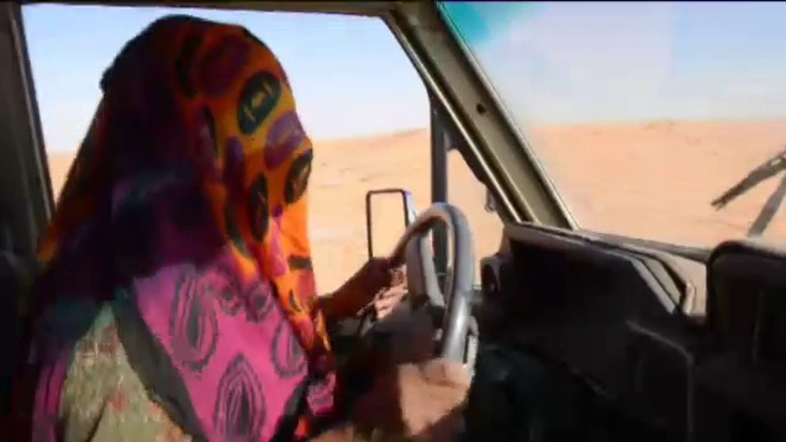
Your faithful blogger somehow missed this article and video when it was published in October, 2016 by al-Arabiyya. Note the subject is covering her face with fabric to retain some privacy, but since she is filmed with her husband and her voice is not disguised, no doubt her family knows she was filmed driving and it's socially accepted among the people living in the desert. The article, including a link to the video of her interview in Arabic is pasted in below and a link to the article is here.
Despite popular beliefs, many women in Saudi Arabia drive their cars
in order to run errands and get from place to place. (Al Arabiya)
Mohammed al-Harbi, AlArabiya.netTuesday, 18 October 2016
She does not own a driver’s license, but that is no obstacle for
Wazna, who has been driving her truck in the open desert of al-Dahna
ever since she was a child.
She has been
driving for such a long time that she knows the entry and exit points of
al-Dahna desert more than her male counterparts.
But Wazna is not alone.
Despite popular beliefs, many women in Saudi Arabia drive their cars in order to run errands and get from place to place.
One woman whom AlArabiya.net spoke to, but
refused to have her photograph taken, said: “I drive a pick-up truck not
for any specific reasons but simply helps me get my daily chores done,
like getting water tanks delivered from their source to our home.”
In
Saudi Arabia, no penal code exists that explicitly states that women
are forbidden from driving. The government simply does not issue any
licenses to women, who mostly rely on personal male drivers or relatives
to get around.
For Wazna, the decision to drive is clear.
“I have to drive as my family depends on me to help them around the desert,” she told AlArabiya.net.
*A version of this article was originally published on AlArabiya.net.
Last Update: Tuesday, 18 October 2016 KSA 19:10 - GMT 16:10
The Gulf News reports on the impassioned argument by Dr. Latifa Al Shaalan, a female member of the Shura Council in favor of women driving. A link to the story is here, and the text is below. The speaker is an associate professor of Psychology, and addresses the many contradictory and challenging issues surrounding the question of women driving. This blogger believes her voice, being raised in this forum, is significant.
Women members of the Saudi Shura Council
Manama: A female member of the Saudi Shura (Consultative) Council has
issued a strong appeal to allow women to drive, saying that it was a
right that cannot be denied on religious, social or economic grounds.
Addressing
a council session, Dr Latifa Al Shaalan said the claim that “the time
is not appropriate yet to allow women to drive as the country is facing
internal and external challenges” was not true or valid.
“We have
been facing internal and external challenges since the state was founded
by King Abdul Aziz, and if we look carefully at our history in the last
50 years, we will say, according to this logic, that no time was ever
appropriate to allow women to drive since we are always in the midst of a
tumultuous ocean of challenges,” she said, quoted by Saudi daily Okaz
on Tuesday.
Saudi Arabia is a vast and influential country with
great political weight located in a sweltering region, and it is normal
that it faces numerous challenges, she added.
“However, these
challenges cannot stall reforms and if we embrace their distorted logic,
then development, reforms and progress in all areas would have stopped
since the existence of challenges makes the time for them
inappropriate,” she said.
Al Shaalan, a writer and an associate professor of psychology, also
refuted the claim that society was not ready to accept the idea of women
driving cars.
“It is incredible how some people demonised Saudi
men and considered him a beast always ready to jump on women. This
prejudice has been repeated so often that it has become a label
characterising Saudi men wherever they go in Saudi Arabia or abroad. It
is an unfair characterisation because Saudi men carry in them and with
them genuine Islamic morals and Arab values. The young people that we
rush to discredit and turn into demons are in fact our sons who grew up
in our homes and graduated from our schools. They often competed in
serving people honestly and protecting our national borders. There are
of course exceptions, but these are deterred by the law,” she said.
The claim that Saudi society is different from other societies is unacceptable and offensive, she added.
“How
is the society in Yemen, Tunisia, Egypt, Iran and Pakistan safe and
allows its women to drive, while our Saudi society with all its great
values not safe? The allegation that our society is not ready for women
drivers is not supported by the reality on the ground. Our society has
accepted the various reforms, such as the membership of women in the
Shura Council and the holding of municipal elections. Our society is
mature and the political authority is strong, stable and determined to
deter those who break the public order,” she said.
The allegation that allowing women to drive was not a priority for the country was a fallacious argument, Al Shaalan said.
“This
claim has opened the door for a wide array of erroneous assertion, as
if allowing women to drive would prevent addressing other issues such as
unemployment and housing. Rights cannot be categorised by priorities
because nobody has the right to decide the scale of priorities which
differ vastly depending on their conditions. What is a priority for some
is not necessarily a priority for others.”
The Shura member said that not allowing women to drive has caused them great harm and stalled their rights and interests.
“This
is totally unfair because one of the major aims of Islam is to ensure
justice for all. Islam has asserted equality between men and women in
the origin of creation, responsibilities and tasks. Islam has asserted
equality in human dignity and civil rights, such as choosing the spouse,
ownership, and all kinds of selling and purchasing transactions. How is
it possible that after all these advantages granted by Islam, women are
not allowed to drive?”
Al Shaalan argued that allowing women to
drive would be beneficial for the national economy and would empower
women economically, especially that unemployment rates among women were
high.
“The fact that women cannot move easily is a formidable
obstacle to them getting jobs, especially in the private sector,” she
said.
On November 29, 2016, Time's Madeline Farber reports that Prince Waleed bin Talal has tweeted in favor of women driving. A link to the story and video is here, and the text and video are pasted below.
"It is high time that Saudi women started driving their cars"
A member of the Saudi royal family has broken with long-established tradition and called for the country to allow women to drive. Prince Alwaleed bin Talal posted a letter Tuesday titled “It is High Time that Saudi Women Started Driving their Cars,” to his Twitter account. Saudi Arabia is the only country where women are not permitted to drive.
“Preventing a woman from driving a car today is an issue of rights
similar to the one that forbade her from receiving an education or
having an independent identity,” he wrote.
Alwaleed went on to list financial, economic, social, religious, and
political factors that women should be allowed to drive there.
Alwaleed wrote that allowing women to drive cars would lead to job
growth, and notes that it comes as a “necessity,” not a “social luxury”
as it has been in the past—writing that there’s an “urgent social demand
predicated upon current economic circumstances.”
But Alwaleed’s beliefs are a drastically different from the country’s deputy crown Prince, Mohammed bin Salman Al Saud. In April, he said that he’s “not convinced about women driving,” citing social, not religious, reasons for his opinion.
Now AFP has come out with a more nuanced report on what happened in the Shoura Council, it was a proposal to make a study about women driving. Apparently this proposal was rejected, seemingly over the proper process.... A link to the story is here, and the text is below, taken from the UK's Daily Mail of November 2, 2016.
Saudi Arabia's Shura Council, which
advises the cabinet, has turned down a proposal to study the issue of
women's driving, a Shura member told AFP on Wednesday. The kingdom has some of the world's tightest restrictions on women, and is the only country where they are not allowed to drive. At
a meeting this week, a male member of the appointed council suggested
the study, said another member who declined to be named. He said the enquiry would have looked at: "What are the difficulties if they start? What is required to allow them to drive?"
But the proposal failed to get the required 50 percent plus one support among the council's 150 members, who include 30 women. The council can make non-binding recommendations to the government but it has no legislative powers. Activists say women's driving is not technically illegal but that the ban is linked to tradition and custom. A slow expansion of women's rights began under the late king Abdullah, who named them to the Shura Council in 2013. He
also announced that women could for the first time vote and run in
municipal elections. At least 20 women were elected for the 2,106
contested council seats last December. Some activists have challenged the driving ban by getting behind the wheel and posting images of themselves online. Other
Saudi women, however, believe change cannot be forced -- a message the
kingdom's powerful Deputy Crown Prince Mohammed bin Salman, 31, gave in
April when he unveiled the Vision 2030 plan for economic diversification
and social change. "So far
the society is not persuaded -- and it has negative influence -- but we
stress that it is up to the Saudi society," he said, commenting on
whether women should drive. The
Vision and its associated National Transformation Programme target an
increase in the proportion of female workforce participation from 23 to
28 percent by 2020.
From the al-Arabiyyah news in the US, comes this story dated October 31, 2016. A link to the story is here and the text is pasted below. I have not seen any domestic news reports of this and am trying to get confirmation.
Al Arabiya English NewsMonday, 31 October 2016
The Saudi Shoura Council rejected a recommendation on women driving cars, in its meeting on Monday.
The council, decided earlier to convene to discuss a bill to “foster an environment conducive to legalize female driving.”
While
some say that in Saudi Arabia, no penal code exists that explicitly
states that women are forbidden from driving, and that the government
simply does not issue licenses to women, some Saudi Shoura Council
members reopened discussion on women driving in the country.
Last Update: Monday, 31 October 2016 KSA 20:08 - GMT 17:08
According to this article in Breitbart, the Saudi Shura Council is about to take up a discussion of the issue of women driving.A link to the story is here, and the text is below. This discussion will be on the heels of another arrest of a woman driving in Mecca. The story is by Ali Wakid, dated October 24, 2016.
A young Saudi woman was arrested after police were notified she was driving a car in Mecca.
The woman, together with two male passengers, was handed over to the
vice squad after intoxicating substances were found in the car.
The three will be indicted for illegal driving and gender mixing.
Meanwhile, the Shura Council, Saudi Arabia’s parliament, will convene
next week to discuss a bill to “foster an environment conducive to
legalize female driving.”
Sultan al Sultan MP has asked the Ministry of Labor and Social
Development and the Interior Ministry to carry out a study into the
matter. Speaking to Al Hayat newspaper, he said that his
proposal was meant to alleviate difficulties of transportation that
families incur given the fact that women are not allowed to drive.
In addition, he said, the cost of hiring a chauffeur often deters women from entering the labor market.
“That’s
why female driving has become a social issue that requires review in
light of the social and security situation, on top of the behavioral
consequences that children face by virtue of having a stranger around
all the time,” he said, providing an economic motive to boot: “More than
a million foreigners work here as chauffeurs, sending their countries
more than 1 billion riyal [$250 million] monthly. We would be better off
if this sum was invested in developing our country.”
“We need to provide for a social environment, especially when it
comes to young drivers, and to provide for an acceptable driving
culture,” he added.
Also on Sunday, the head of the Saudi Chamber of Commerce in the kingdom’s south-east said that women “make up 50 per cent of university graduates but only 22 per cent of the workforce.”
He said he hoped that Prince Mohammed’s Vision 2030 plan would help reduce that disparity.