This appeared on 11/24/14 in the Mailonline. A link to the story is here.
Story pasted below.
Princess
Ameerah, the former wife of a multi-billionaire Saudi Arabian royal has
vowed to fight to win the basic right for women in the kingdom to drive
a car, telling MailOnline that it 'can happen overnight'.
As
a princess with a wo
EXCLUSIVE - From a £20bn divorce to steering change in Saudi Arabia: The glamorous princess leading the battle against kingdom's female driving ban (and why she loves to get behind wheel of her Mini Cooper)
- Ameerah, 31, who divorced £20bn Prince Alwaleed bin Talal last year spoke to MailOnline about her campaign to emancipate women
- Hopes ban will be lifted in very near future 'with a little bit more pressure'
- Enjoys driving a £15,000 Mini Cooper when in Europe and America
- Desert kingdom forbids women driving and it has been reported that one woman was given 150 lashes for getting behind the wheel recently
- Campaign of defiance has seen women uploading videos of them in cars
Princess
Ameerah, the former wife of a multi-billionaire Saudi Arabian royal has
vowed to fight to win the basic right for women in the kingdom to drive
a car, telling MailOnline that it 'can happen overnight'.
As
a princess with a wonderfully privileged life, she is accustomed to
being driven from palace to penthouse in chauffeur-driven limousines.
She used one as a guest of honour at the Westminster Abbey marriage of
Prince William and the then Kate Middleton in 2011, and regularly
socialised with Prince Charles.
But
now a divorcee, Ameerah, 31, said in an interview that she is currently
just as comfortable in her own modest £15,000 Mini Cooper which she
drives when she is in Europe and America.
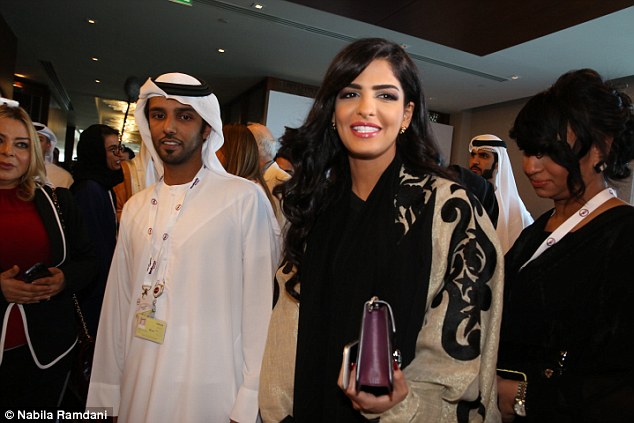
Influence: The glamorous princess spoke to MailOnline at the 5th Abu Dhabi Media Summit in UAW lat week
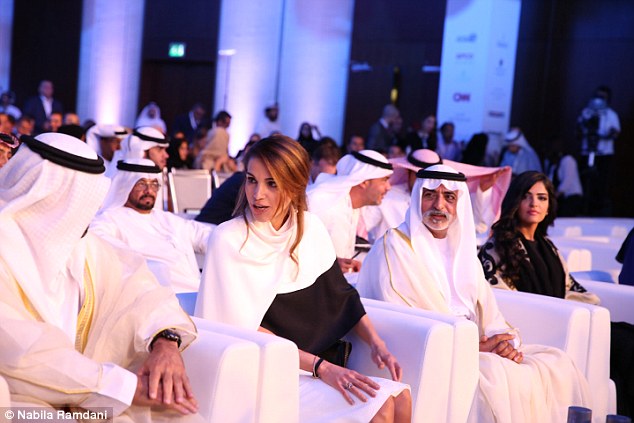
Inspirational: Princess Ameerah, right, and Queen Rania of Jordan, left, are powerful drivers of change
Women in her desert kingdom cannot enjoy that simple pleasure and she is determined to see them similarly empowered.
She
told MailOnline at the 5th Abu Dhabi Media Summit in the United Arab
Emirates last week: 'It is my job and duty to use my power and influence
to highlight these kind of issues and to try to find solutions. I am
offered platforms to speak around the world, and I must use them to try
to change things.'
Women
have been barred from driving in Saudi Arabia since the establishment
of the state in 1932 and earlier this year, a woman reportedly received
150 lashes after being caught behind the wheel.
But Ameerah is confident that – with a little bit more pressure – the government will lift the ban shortly.
She said: 'It will be a hugely important step, and it can happen overnight'.
Protests
and acts of defiance against the ban have grown in recent years, with
women posting videos of them behind the wheel to social media. The
latest campaign day was held on October 26.
The
World Economic Forum’s annual report on gender rights regularly
portrays Saudi Arabia as one of the worst countries for women. And the
driving ban is a potent symbol of their inferior status.
Every
single Saudi woman has to have a 'male guardian', typically their
husband or father or brother, who has the same legal power over her as a
parent has over a child.
She
requires formal permission for almost all activities, including
working, travelling, and sport, and depends on him financially and for
housing.
Ameerah
said: 'I don't believe the ban will go on indefinitely. It will be like
the decree calling for 20 per cent of Parliament to be made up of women
– a surprising development, but one which happened very rapidly.
'I believe that it is the generation of young people in Saudi Arabia which is going to accelerate change in the country.'
Among
those 'leading the way', said Ameerah, is Prince Turki bin Abdullah Al
Saud, a young royal and Governor of the Riyadh Province who is also a
Leeds University PhD candidate.
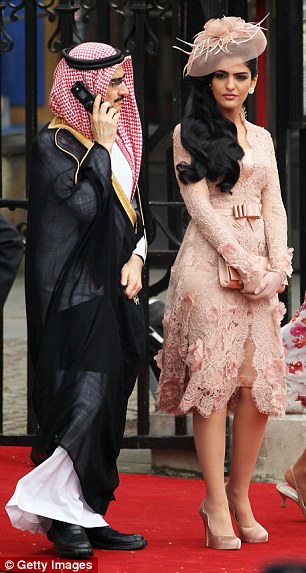
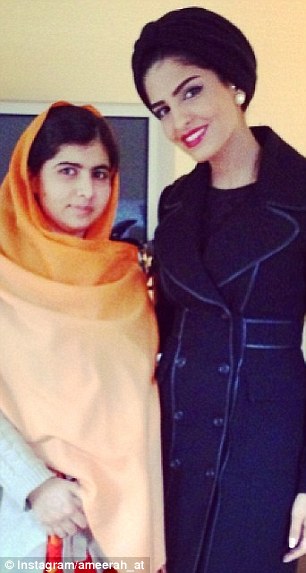
Privilege:
Princess Ameerah, pictured with her former husband Prince Alwaleed bin
Talal at The Duke and Duchess of Cambridge's wedding, and right with
Malala Yousafzai, said: 'It is my job and duty to use my power and
influence to highlight these kind of issues and to try to find
solutions'
Ameerah
said Saudi women currently have to employ a driver, and that proves
impossibly expensive for many. It can cost up to £340 a month.
Of
her own driving experiences, she said: 'We still can't officially drive
in the cities and towns, but I have driven in the desert many times.'
'I
have an international license and drive a Mini Cooper when I am in
Europe and America. I find the GPS very helpful,' Ameerah added. 'I do
not drive in London or anywhere in the UK, however, because driving on
the left is quite confusing.'
Ameerah said two wheels could be just as good as four too, adding: 'I ride bikes from time to time.'
But
even cycling in Saudi Arabia is a pursuit that is severely restricted
for women - they can only do so in so-called 'recreational areas', while
dressed in full Islamic body coverings and accompanied by their male
guardian.
An
ultraconservative interpretation of Islam means women can only use
their bikes 'for entertainment' too, rather than for work or other
purposes.
I believe that it is the generation of young people in Saudi Arabia which is going to accelerate change in the country
These are just the type of restrictions which the Saudi women calling for emancipation want to see lifted.
There
was good news last month when some of those taking part in a closed
session of the Saudi King's advisory council apparently recommended
women over 30, wearing no make-up, should be allowed to drive between
7am and 8pm.
An official spokesman for the council denied any policies were agreed, but the claims at least provided encouragement.
The
kingdom is the only country in the world that forbids women from
driving, but there has been a positive response to groups of female
activists posting pictures and videos of them driving on social media.
This is all part of a movement which has seen women ‘taking responsibility for their future’ using new technology, said Ameerah.
Speaking
to MailOnline about the remarkable transformation in her life, Ameerah
said she was coping well from her split from Prince Alwaleed bin Talal -
one of the richest men in the world.
Raised
in a middle-class home in Riyadh, Ameerah famously arranged a short
interview with Prince Alwaleed as part of a school journalism project
when she was just 18.
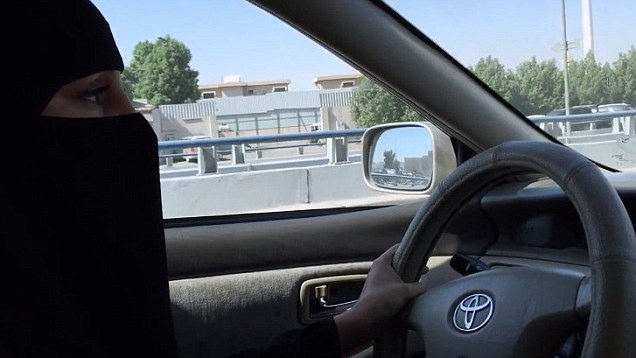
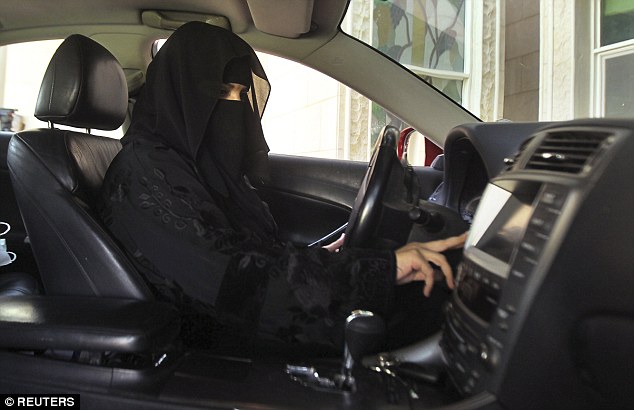
Defiance: Women in Saudi Arabia have
begun to use social media to post videos of them driving in protest at
the ban. There are reports that one women was given 150 lashes for being
caught behind the wheel

They were meant to talk for 10 minutes, but got on so well that the conversation lasted for two hours.
'We
just clicked,' she said of the now 59-year-old royal, whose vast
fortune includes assets such as the legendary George V Hotel in Paris
and Plaza in Manhattan, and who is known as the 'Arabian Warren
Buffett'.
Their
marriage, which took place within a year, was very low-key to begin
with – it was not even made public until 2009 – but Ameerah was handed
the fairytale life of an Arab Princess.
But that hit the buffers last year, however, and the hugely glamorous couple divorced early in 2013.
They remain 'great friends', with Ameerah also still describing the Prince as 'my mentor'.
Ameerah,
whose divorce settlement as the Prince’s fourth wife remains
undisclosed, has thrown herself into work – especially philanthropic
causes, and her production company, Time Entertainment.
She
also runs Tasamy in Saudi Arabia, a centre for people who want to
volunteer for public service so as to 'make their country a better
place,' said Ameerah.
She
is fast becoming one of the most influential Arab women in the world,
working closely with world figures including Queen Rania of Jordan, and
former US Secretary of State Hillary Clinton.
I
have an international license and drive a Mini Cooper when I am in
Europe and America... I do not drive in London or anywhere in the UK,
however, because driving on the left is quite confusing
Activists
behind the driving rights movement which started in 2011 are part of a
larger protest against state oppression, but Ameerah believes the battle
is being won.
She said: 'Saudi women are doing incredible things – we're making progress all the time.'
She
has more than a million followers on social media sites including
Twitter and Instagram, and sees the web as being hugely important for
women to get their message across.
Referring
to some 83 per cent of under 25s in the Middle East and North Africa
who have access to the internet, Ameerah said: 'to be connected is also
about being mobile, travelling, working with people globally.'
She
admitted there were too many inconsistencies in Saudi Arabia, where a
substantial part of Parliament is made up of women, but where men and
women still have to use different doors to get into buildings.
'The
web gives women equal opportunities,' she said. 'Women can set up their
business online, prosper and be successful, and they can have a voice
too through social media.'
Women’s rights have been improving slowly since King Abdullah Bin Abdul Aziz Al Saud came to power in August 2005.
He appointed 30 women to the Shura, his advisory council, in a historic breakthrough for Saudi society.
This
sets the stage for 2015, when a new decree not only allows women to
vote in municipal elections for the first time, but they will be able to
run for local government office too.
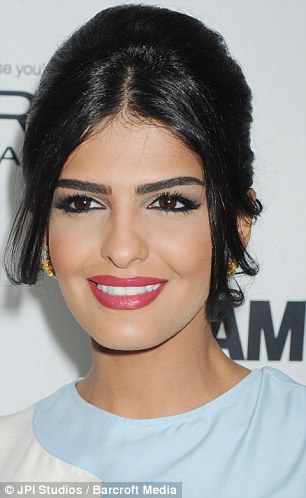
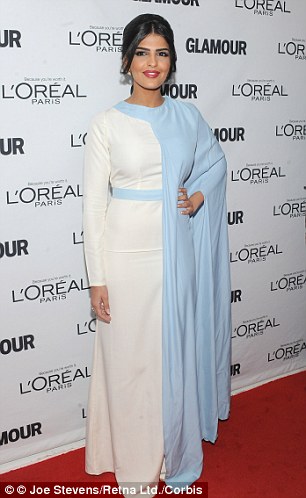
Hopes: Ameerah said: 'Saudi women are doing incredible things – we're making progress all the time'
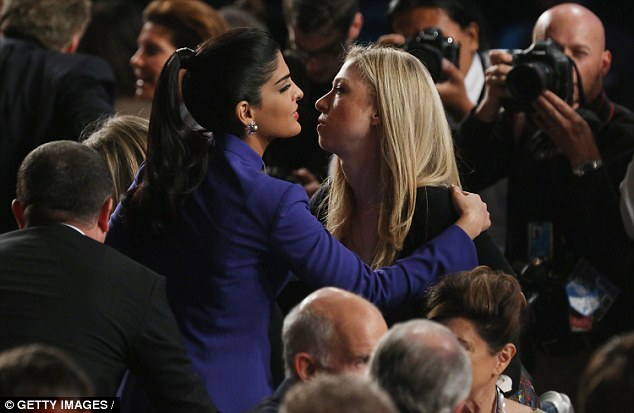
Friends in high places: The Princess
kisses Chelsea Clinton. Ameerah has been praised by leaders around the
world for her efforts in promoting equal rights in Saudi Arabia and the
Middle East
Ambitious
economic plans have also seen increases in the number of women finding
employment in the private sector and going to university.
More
generally, Saudi women are being recognised as major public figures,
rather than individuals who have to stay in the background.
One
of Ameerah’s proudest moments came in 2011, when, in the same year as
Prince William’s wedding, she received the 800th Anniversary Medal for
Outstanding Philanthropy from Prince Philip.
She
said: 'It was truly amazing to receive such an award from the Prince. I
really appreciated it coming from a person who has so much experience
of life. It was such an honour to speak to him.
'Both the British Royal Family and the British public are renowned for their generosity and good works.'
Chelsea
Clinton, the only daughter of Bill and Hillary Clinton, has said:
'Ameerah's advocacy on behalf of Saudi women has provided a tremendous
contribution to how we think about the rights of girls and women around
the world.'
Ameerah
said her own motto in life is: 'Throw yourself over the edge that
you're always scared of. Try being independent; do it your way. You'll
love it.'

